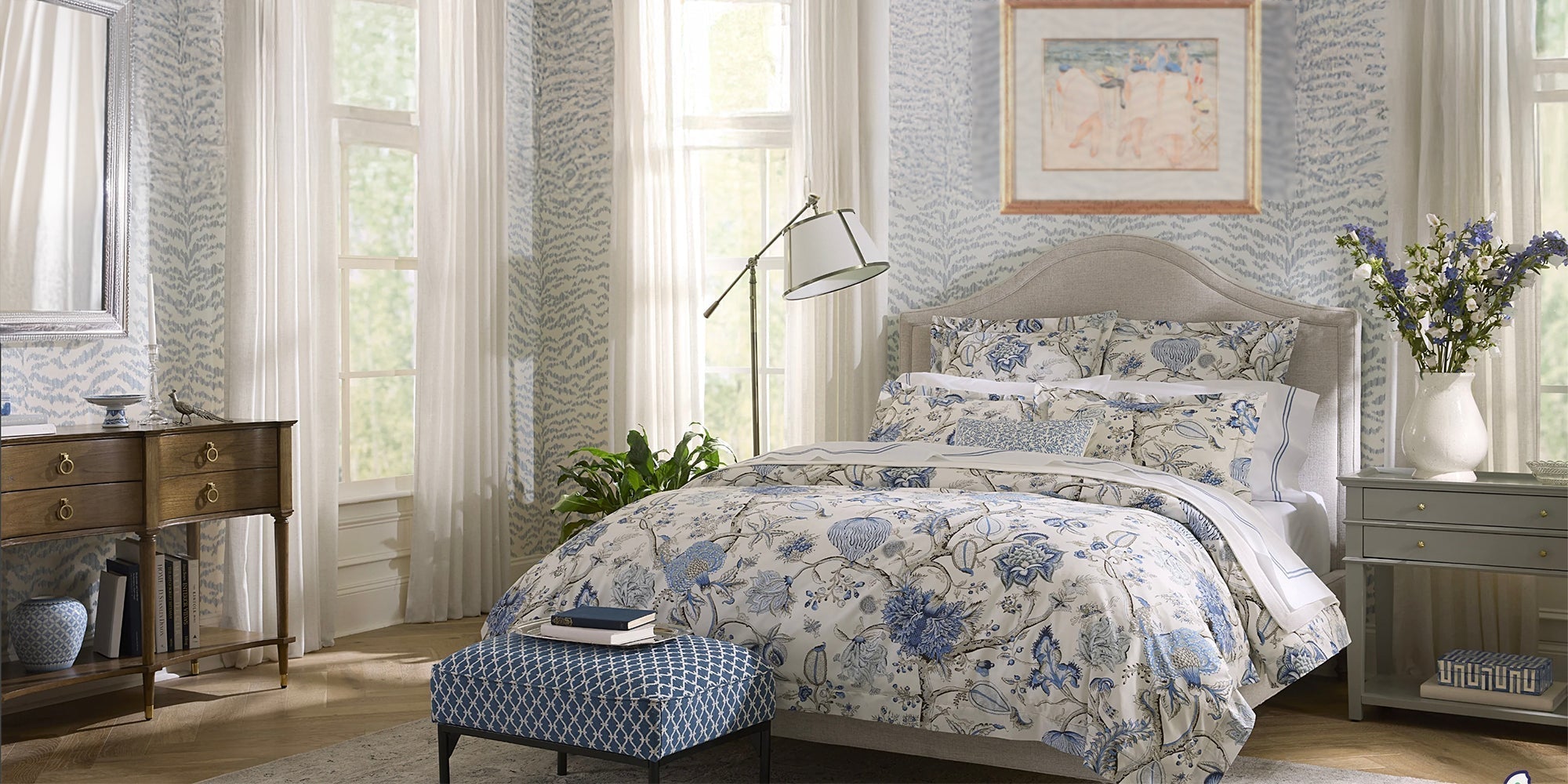
How to Dress a Bed: The Anatomy of a Well-Made Bed
A well-dressed bed rarely announces itself. It is not the boldest object in the room, and it does not need to be. It simply feels right the moment you walk in — cool enough to invite you in at night, substantial enough to look composed by morning. That effect is not the result of a single beautiful duvet. It is the result of layering, the same principle that governs a well-dressed table or a well-hung gallery wall: several honest materials, each doing one job, working together.
Begin with the Sheet
Everything else sits on top of the sheet, so it is worth choosing well. A fine long-staple cotton or linen percale reads crisp and cool; a sateen weave has more drape and a subtle sheen. Neither is more correct than the other — the choice is really about how the room feels the rest of the year. What matters more is restraint in color. A quiet ground, in white, ivory, or a soft stone, gives every layer that follows room to be seen rather than competed with.
The Weight of a Coverlet or Duvet
This is the layer that sets the season and the silhouette. A matelassé coverlet has structure and a bit of relief in its weave, so it holds a fold well and photographs beautifully at the foot of the bed. A duvet, by contrast, is softer and rounder, better suited to a bed that wants to look inviting rather than tailored. Neither should match the sheet exactly. A shade or two of contrast — cream against white, stone against ivory — is what keeps the bed from reading as a single flat plane.
Pillows: Structure Before Softness
The most common mistake is treating pillows as an afterthought, added at the end in whatever is left over. They deserve the same sequencing as everything else: firm sleeping pillows first, dressed in shams that match or gently echo the sheet; then one or two structured decorative pillows in a heavier weave or a quiet pattern; then, only at the very front, something soft and irregular — a linen lumbar, a small velvet square — to break the symmetry. Three sizes, three weights, is usually enough. More than that and the bed starts to look like a display rather than a place to sleep.
The Finishing Layer: Throws and Texture
A throw folded at the foot of the bed, or draped loosely over one corner, is what makes the whole arrangement look lived-in rather than staged. Choose it for texture as much as color — a nubby wool, a brushed alpaca, a substantial linen — so the eye has somewhere new to land after taking in the smoother planes of the sheet and coverlet. This is also the layer most worth changing with the seasons, since it asks the least commitment and does the most to shift a room's mood.
A bed built in these layers rarely needs to be redone all at once. Most clients start with a foundation of fine linens and add texture and structure over time, piece by piece, until the arrangement feels entirely their own. If you would like guidance on building yours, our Bed Linens collection, including pieces from SFERRA and Lily Alessandra, is a good place to begin, or reach out through Interior Design for a more considered, room-by-room approach.